Camera Company
Company
Shop By Category
T&Cs
Shop Online
  • The maker's specifications on every page
  • Free tracked Canada-wide delivery over $150
  • 14-day returns

Hard Shell Camera Backpack | Hard side camera case | Backpack for photographers

Hard Shell Camera Backpack Case

$139.99 $167.99 Save $28
  • Hard Shell Build
  • Waterproof Cover
  • Eight Compartments
  • Back Panel Access

Price: $139.99 $167.99

  • Free tracked Canada-wide delivery on orders $150+, otherwise a flat $20
  • Pay by card or PayPal, handled by the payment provider
  • 14 days to change your mind, plus your statutory rights
Product specifications
StyleHardcase Camera Backpack
Shell TypeHard
MaterialEVA hard shell, 1200D nylon, polyester
Capacity13 litres inner volume per the description, 12 litres in the specification table
Stated Gear CapacityUp to 1 to 2 cameras, 5 to 6 lenses and accessories
Number of Compartments8
Closure TypeZipper
Strap TypeAdjustable
Handle TypeShoulder strap and top handle
Pocket DescriptionUtility pocket and concealed pocket
Water Resistance LevelWaterproof
ColourBlack
PatternSolid
SizeLarge
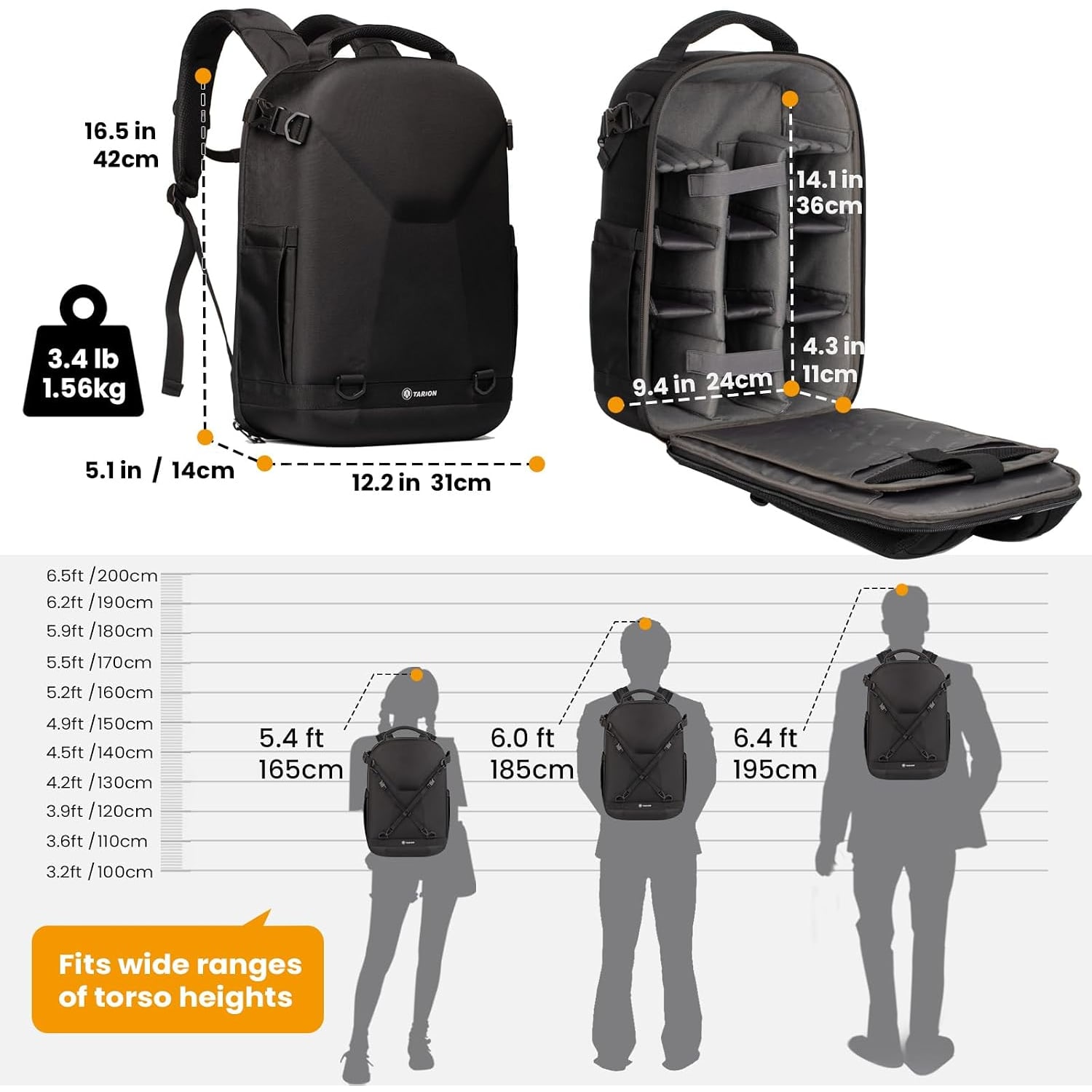
Item Dimensions (L x W x H)12.2 in x 5.1 in x 16.5 in
Item Weight1.56 kg (3.4 lb) per the description, 1.5 kg in the specification table
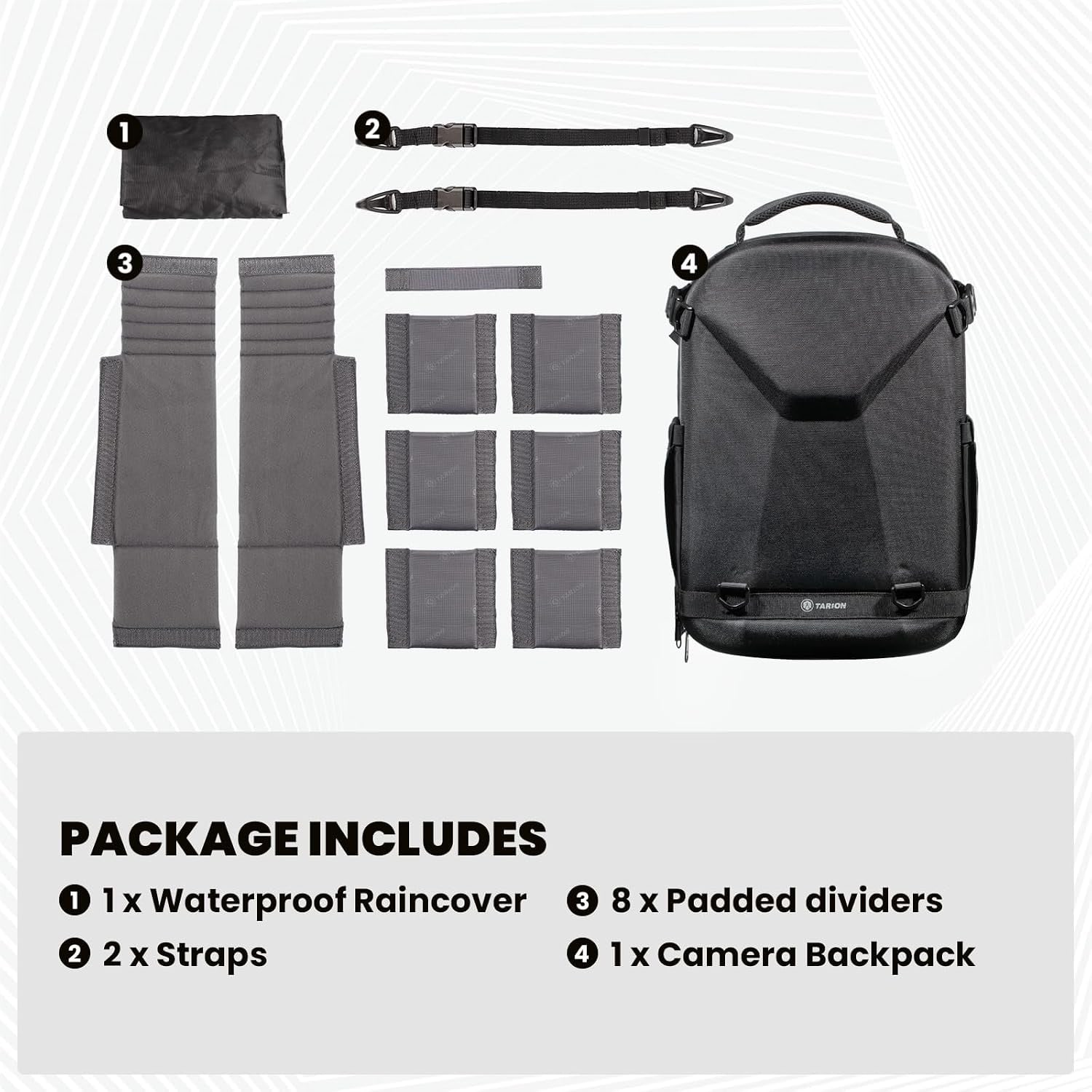
Included Accessories1 waterproof rain cover, 2 X-cross straps
Laptop Compartment14.5 inch
Model NumberTRH-GN-EUS
Number of Packs1
Unit Count1 count
Item TypeCamera bag, camera backpack
Weight1.5 kg
Shipping & returns

Tracked delivery anywhere in Canada. It is free on orders of $150 or more, and a flat $20 below that.

If it is not right for you, send it back within 14 days of delivery in resaleable condition and we refund the price you paid, including standard delivery. That is a voluntary policy we offer on top of your legal rights. You cover the cost of returning it unless the item is faulty.

If it arrives faulty, damaged or not as described, we put it right at no cost to you under the consumer protection law of your province or territory (for example the Ontario Consumer Protection Act, 2002), return postage included.

Shipping details · Refunds and returns

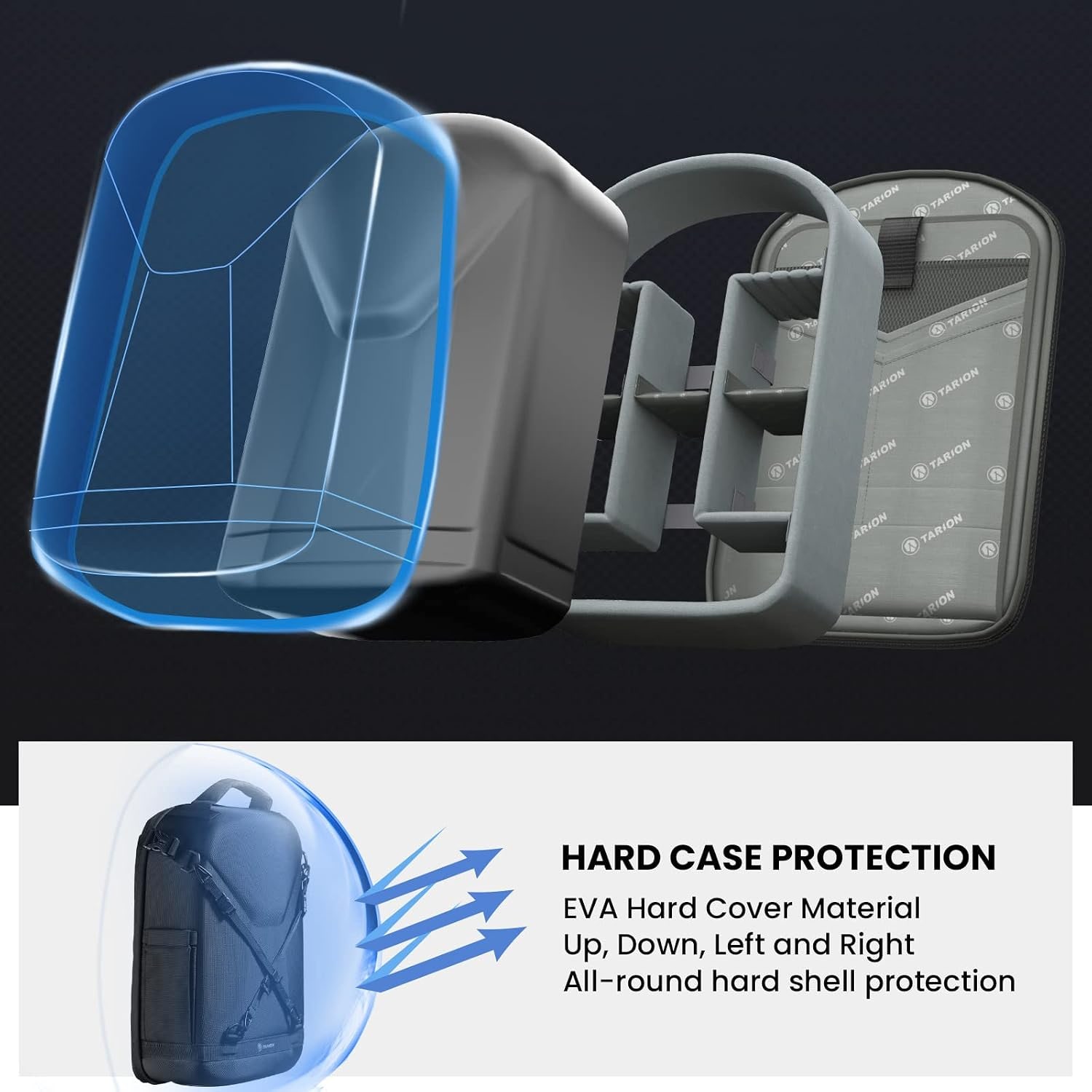
Hard Shell BuildA one-piece EVA hard shell with thick inner padding.
Waterproof CoverWater resistant construction plus an included rain cover for downpours.
Eight CompartmentsModular dividers, side pockets and a 14.5 inch laptop sleeve.
Back Panel AccessMain compartment opens against your back, not out in the open.

A hard shell camera backpack that takes the knocks so your camera body and lenses never have to.

One-piece EVA hard shell construction, eight compartments, a 14.5 inch laptop sleeve, X-cross external straps and a waterproof rain cover, all in a compact pack with a stated 13 litre inner volume.

A hard shell camera backpack built around a rigid case, so a knocked tripod or a dropped bag does not reach your lenses.

The main compartment uses modular dividers and, per the maker, holds up to 1 to 2 cameras and 5 to 6 lenses.

A 14.5 inch laptop sleeve sits at the back with extra pockets for a tablet, cables, filters and cards.

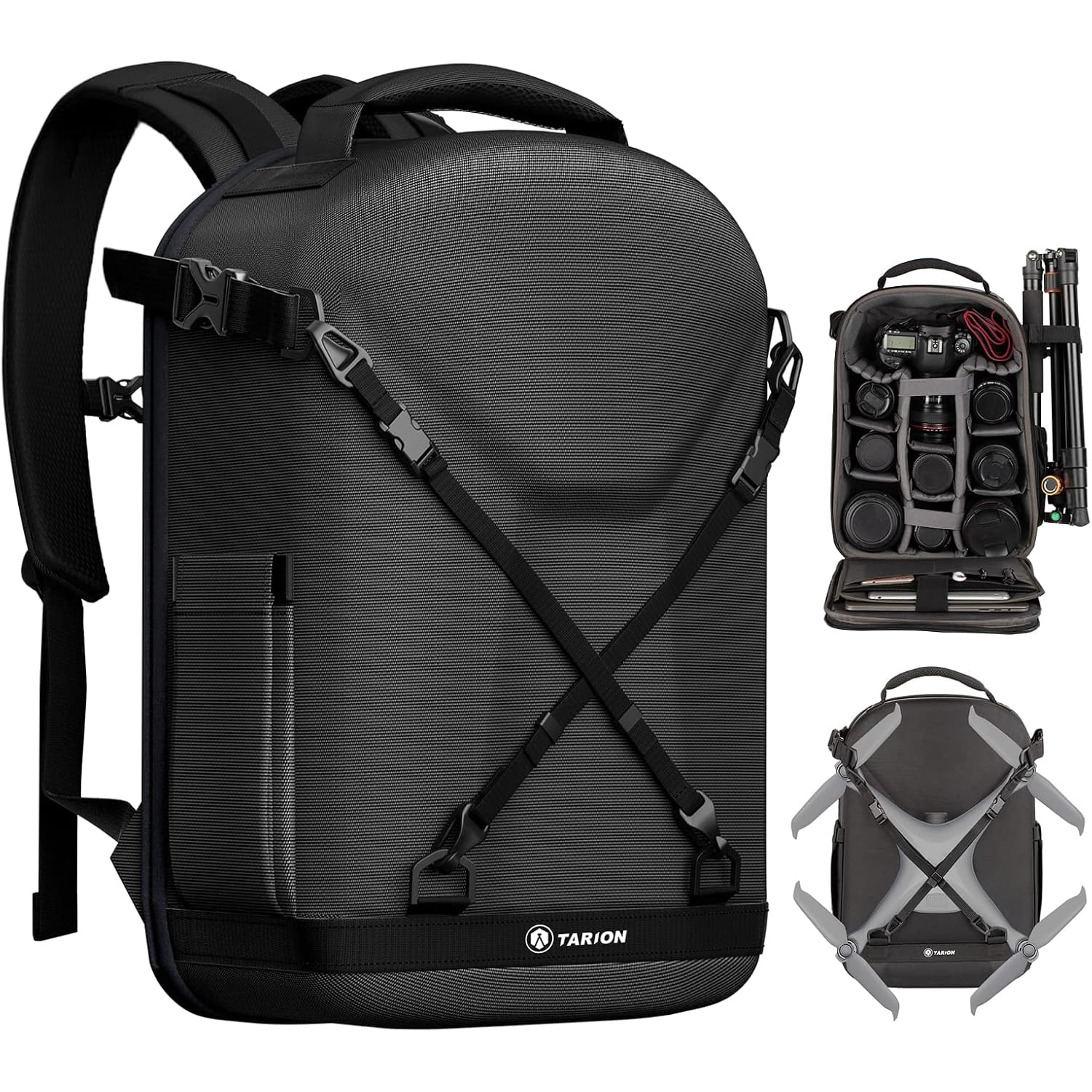
X-cross straps on the front carry a larger drone, a sleeping bag or a lens bag, with quick release clips for fast removal.

A waterproof rain cover is included, and the zippered closure keeps everything shut on the trail or in a crowded station.

Hard Shell Camera Backpack Case

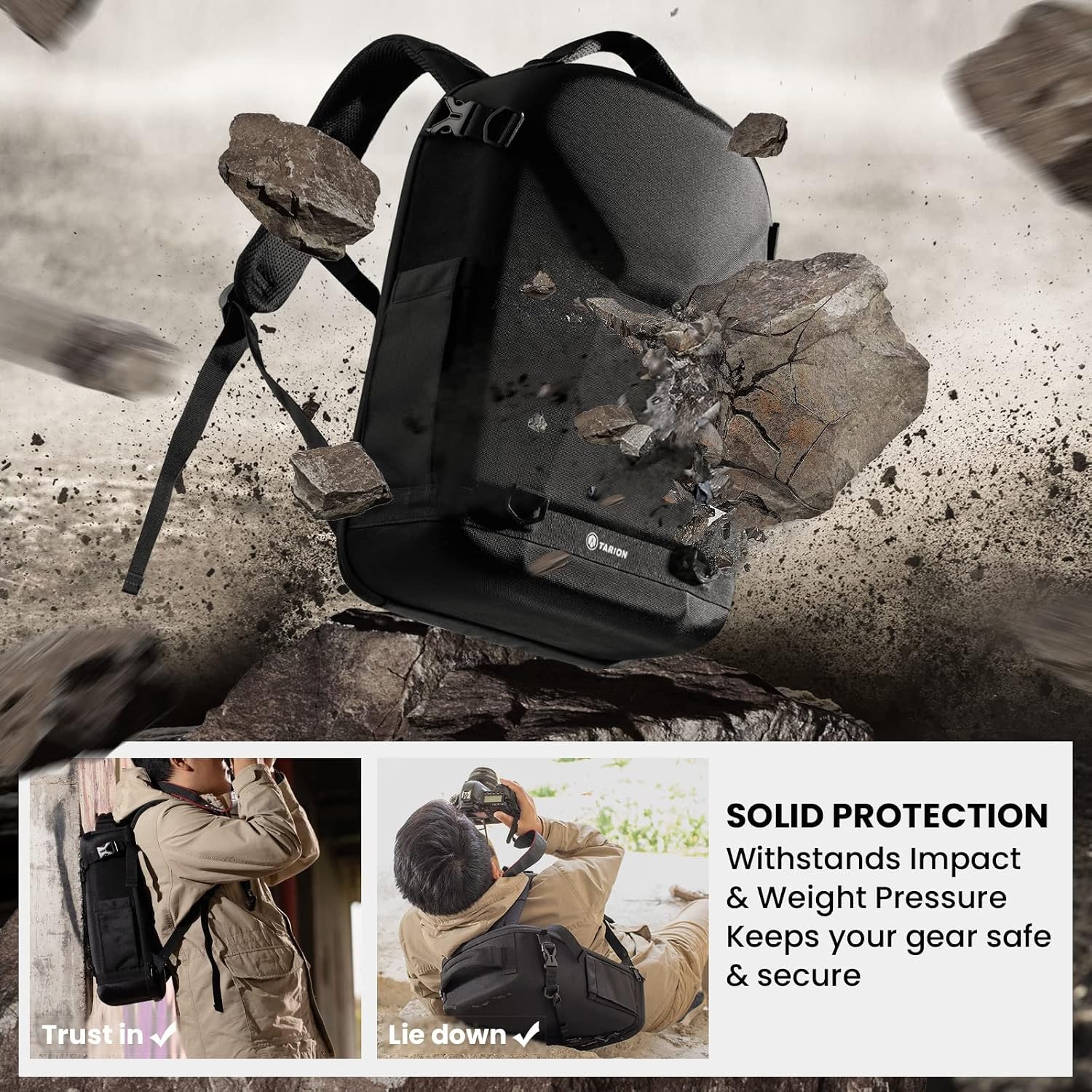
Most camera bags are soft bags with padding sewn inside. They work until something heavy lands on them, until a bag gets thrown in a trunk, or until a seatback presses into the side of the pack on a long bus ride. This hard shell camera backpack takes a different approach. The case itself is rigid, so the shape holds and the pressure spreads across the shell instead of pushing straight into your gear. The maker describes it as an EVA hard shell made all in one piece, a 3-side hard case with thick inner padding, and says it is shockproof and withstands high weight pressure.

Hard Shell Camera Backpack Case

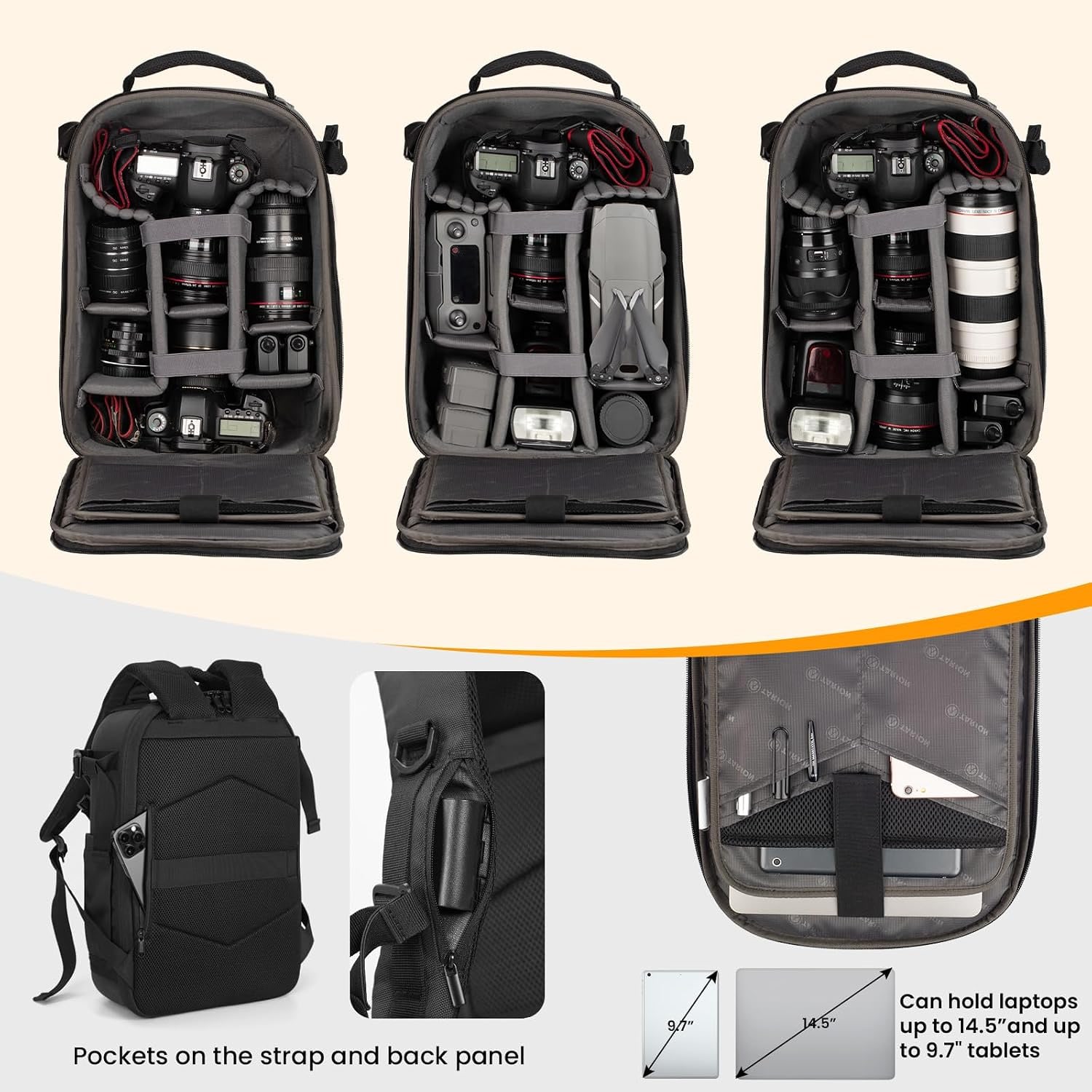
Inside, the maker gives 13 litres of inner volume (12 litres in its specification table) across eight compartments, enough by its count for up to 1 to 2 cameras and 5 to 6 lenses. The main camera section uses modular dividers you can move, which matters more than raw volume. A body with a short prime, three small lenses and a flash packs very differently from a body with a long zoom mounted. Set the walls where your gear wants them and everything stays put instead of sliding around. Tripod and accessory pockets on each side have safety straps, and there are utility pockets plus a concealed pocket for the small items that always go missing.

Hard Shell Camera Backpack Case

The back panel holds a 14.5 inch laptop sleeve with extra pockets for a tablet, a notebook or chargers. Because the main opening is on the back panel and runs on zippers, the pack sits against your body with the access side facing you. That is a simple idea that makes a real difference in a busy market, a train platform or anywhere you would rather not have a wide zipper facing the crowd. The top handle lets you grab it off a floor or a conveyor without hunting for a strap.

Hard Shell Camera Backpack Case

On the front, X-cross straps give you a place to strap bulkier items such as a larger drone, a sleeping bag or a lens bag. Quick release clips mean you can take the load off fast rather than unthreading webbing. A waterproof rain cover is included, so when the sky opens you can keep the shell dry rather than trusting the fabric alone. The maker gives the weight as 1.56 kg (3.4 lb) in its description and 1.5 kg in its specification table.

Hard Shell Camera Backpack Case

The outer dimensions are 12.2 inches long, 5.1 inches wide and 16.5 inches high. That is a compact footprint for a day of shooting, a weekend trip or a commute where the pack doubles as a work bag. It is a sensible pick for anyone who moves between a desk and a location, who shoots outdoors, or who simply wants the best hard shell camera backpack option rather than another soft bag that flexes when it should not.

Not sure yet? That is fine.

A camera has to suit the job you bought it for, and you cannot always judge that from a photograph. If it is not right for you, send it back within 14 days of delivery in resaleable condition and we refund the price you paid, including standard delivery. That is a voluntary policy we offer on top of your legal rights.

If it turns up faulty, damaged or not as described, that is on us. The consumer protection law of your province or territory covers you, and we pay the return postage. Read the full detail on our refunds and returns page, or ask us anything before you order.

Frequently Asked Questions

What is a hard shell camera backpack?

It is a camera backpack built around a rigid outer case rather than only soft padding. The shell holds its shape under pressure and spreads impact across the surface instead of letting it reach your gear. The maker describes an EVA hard shell made all in one piece with thick inner padding, and calls it a 3-side hard case.

How much gear does it hold?

The maker says it holds up to 1 to 2 cameras, 5 to 6 lenses and accessories. Its description gives 13 litres of inner volume, and its specification table gives 12 litres. The main camera section uses modular dividers, and exact fit depends on how large your lenses are.

What are the outside dimensions?

The outer dimensions are approximately 12.2 inches long, 5.1 inches wide and 16.5 inches high. That is a compact day-pack footprint rather than a large expedition bag. Measure your longest lens before ordering if you shoot with big telephoto glass.

How much does it weigh?

The maker gives 1.56 kg (3.4 lb) in its description and 1.5 kg in its specification table. It describes that as lightweight for a hard shell pack.

Does it fit a laptop?

Yes, there is a 14.5 inch laptop compartment in the back panel. There are also additional pockets there for a tablet or papers. Check your laptop's dimensions against that figure if you use a larger machine.

Is it waterproof?

The maker's description calls the shell water resistant, its specification table says waterproof, and a waterproof rain cover is included. In practice, treat the shell as water resistant and pull the cover on for sustained rain. No zippered bag should be submerged.

Where does the main compartment open?

The camera and laptop compartment is only accessible from the back, secured with double zippers. That means the access side faces your body while you wear it. It is a practical layout for travel and crowded places.

Can I carry a tripod?

Yes. There are tripod and accessory pockets on each side with safety straps. The front X-cross straps are there for larger items that do not fit a side pocket.

Will it carry a drone?

The X-cross straps on the front are designed to hold bulkier items such as a drone, and the main compartment can be configured with dividers for one. Fit depends on the drone's folded size. Compare your drone's dimensions to the 12.2 by 5.1 by 16.5 inch outer size.

What material is the pack made from?

The maker gives the materials as EVA, 1200D nylon and polyester. The hard shell is EVA, made all in one piece, with thick inner padding. The structure comes from the rigid case rather than from stiffeners sewn into fabric.

What colour is it?

It comes in black with a solid pattern. Black hides scuffs and dust well, which suits a bag that gets set down on gravel, floors and tailgates.

Does it work as an everyday backpack?

It can. With the dividers rearranged or removed from part of the space, the laptop sleeve and utility pockets make it workable as a commuter bag on non-shooting days.

How many compartments are there?

Eight in total. That covers the main camera section, the laptop sleeve, side pockets, utility pockets and a concealed pocket. The count gives you somewhere specific for small items instead of one big cavity.

What is the concealed pocket for?

The maker lists a concealed pocket alongside the utility pockets and does not describe it further. A pocket like that suits small items you want kept apart from loose cables and lens caps.

Is there a top handle?

Yes, handle type is listed as shoulder strap and top handle. The grab handle is useful for lifting the pack off a floor, a luggage belt or an overhead shelf. It also helps when you want to pass it to someone.

Are the shoulder straps adjustable?

Yes, strap type is listed as adjustable. Set the straps so the pack sits high on your back with the weight close to your spine. That keeps a loaded camera backpack comfortable on longer walks.

Can I remove the dividers?

The main compartment uses modular dividers, so you can move them to suit your gear. Removing some of them opens up a larger single space. Put them back when you return to a lens-heavy setup.

Does it suit mirrorless as well as DSLR?

Yes. The divider system means you can tighten the spaces down for a smaller mirrorless body and compact lenses, or open them out for a larger DSLR with a grip. A good mirrorless camera bag is really just one that adapts to the gear you own.

Will it fit under an airline seat or in an overhead bin?

At 12.2 by 5.1 by 16.5 inches it is on the compact side for a backpack, but cabin rules vary by airline and aircraft. Always check your carrier's current size limits before you fly. Carry irreplaceable bodies and lenses in the cabin where you can.

Is it good for hiking?

The padded back panel and adjustable straps are built for carrying, and the rain cover helps on exposed trails. For a long multi-day hike you would want more volume. For a day of landscape or wildlife shooting it works well as a hiking camera backpack.

How do I clean it?

Wipe the shell with a damp cloth and mild soap, then dry it fully. Spot clean fabric panels and straps by hand. Do not machine wash, tumble dry or iron it.

How should I store it?

Empty it, open the zippers and leave it somewhere dry and out of direct sunlight. Storing it stuffed and damp is hard on zippers and padding. Dry the rain cover before folding it away.

Does the rain cover come with the bag?

Yes, one waterproof rain cover is included, along with two X-cross straps. Keep it in a pocket you can reach without unpacking, because rain rarely waits. Rinse and dry it after a muddy day.

What is the model number?

The model number is TRH-GN-EUS. Quote it if you ever need to ask us about this exact pack. Brand information is not specified by the maker.

Who is this bag best for?

Photographers who travel, shoot outdoors or move through busy places and want structural protection rather than padding alone. It also suits anyone carrying a camera and a laptop in the same bag. If you shoot with very long lenses, a larger case will serve you better.

Can I strap a sleeping bag or other bulky items outside?

Yes. The maker says the front X-cross straps can be used to attach larger drones, sleeping bags and lens bags, with quick release clips and an adjusting buckle on each strap. That keeps the interior free for gear. The clips let you pull the load off quickly when the weather changes.

Does the hard shell make it uncomfortable?

The back panel is padded and the shoulder straps are adjustable, so the rigid part sits away from your back. A hard case actually helps comfort in one way, because it stops gear from pressing into your spine. The maker describes an ergonomically padded back panel and shoulder straps with an air-grille design.

How is delivery handled?

Orders ship by tracked delivery to Canadian addresses only, and most arrive in 4 to 7 business days. Shipping is free on orders of $150 or more and a flat $20 under that. You will get tracking by email once the pack leaves the warehouse.

Does it make a good gift for a photographer?

It does, because it is useful to almost anyone with a camera and it does not depend on them owning a specific brand of body. The adjustable dividers mean it adapts to whatever gear they already have. It is a safe choice when you do not know exactly what is in their bag.

What if it is not right for me?

Returns are accepted within 14 days of delivery in resaleable condition with the rain cover and straps included, and you pay the return shipping. Get in touch and we will walk you through it and send return instructions. If you tell us what did not work, we can usually point you to a size or layout that fits better.

How to Choose a Hard Shell Camera Backpack

6 min read Camera Company

The problem with soft camera bags

Most of us start with a padded shoulder bag or a soft backpack. They are light, they are cheap, and for a while they are fine. Then something happens. A bag gets stacked under a suitcase. Someone sets a heavy box on it in the back of a van. You lean against a doorway and feel the lens barrel press through the fabric into your ribs. Padding slows an impact down, but it does not stop pressure, because padding squashes.

A hard shell camera backpack changes the physics. The rigid case holds its shape, so a load pressing on one point gets spread across the whole panel instead of pushing straight through to a lens mount. The maker describes this one as an EVA hard shell made all in one piece, a 3-side hard case. The back panel is padded because that is the side against you.

That is the whole argument for a hard side camera case, and it is a simple one. You are buying structure.

What is actually in the bag

The maker gives the inner volume as 13 litres in its description and 12 litres in its specification table, across eight compartments. By its count that is room for up to 1 to 2 cameras, 5 to 6 lenses and accessories.

The main camera section sits behind the back panel and uses modular dividers. You move the walls to match your gear. If you shoot with one body and four small primes, you build four narrow slots. If you run a zoom permanently mounted, you open a tall channel for it and shrink everything else. This matters more than total volume, because gear that can slide is gear that can knock into other gear.

Behind that sits a 14.5 inch laptop compartment with extra pockets for a tablet, cables and paperwork. That turns the pack from a camera-only bag into something you can take to a job, a client meeting or a desk. A camera backpack with laptop compartment earns its keep on the days you are not shooting at all.

Outside there are tripod and accessory pockets on each side with safety straps. Up front, X-cross straps with quick release clips handle whatever does not fit inside, such as a larger drone, a sleeping bag or a lens bag. The clips matter. Webbing you have to unthread is webbing you stop using.

A waterproof rain cover comes with the pack. The description calls the shell water resistant, so the sensible way to use it is shell for drizzle, cover for real rain.

The back-panel opening

The main compartment opens on the back panel rather than the front. When the pack is on your shoulders, the big zipper faces your spine.

Two practical results come from that. First, in a packed train car or a street market, nobody can get at the zipper while you are wearing it. Second, when you set the bag down to shoot, the outside face that touches wet ground is the hard shell, not the opening. Lay it shell-down, unzip, pull your lens, zip up. Your gear never touches the dirt.

It takes a day or two to retrain your hands if you have always used front-opening bags. After that you stop noticing.

Size and weight, honestly

Outer dimensions are 12.2 inches long, 5.1 inches wide and 16.5 inches high. The maker gives the weight as 1.56 kg (3.4 lb) in its description and 1.5 kg in its specification table.

The 5.1 inch depth is the number to pay attention to. It is slim, which is what makes the pack comfortable to wear and easy to slide into a bin or under a desk. It is also what rules out very long lenses. If you own a very long telephoto, measure it against the outer dimensions before you order. The maker's own count is up to 1 to 2 cameras and 5 to 6 lenses with accessories.

On weight, around 1.5 kg empty is more than a thin nylon pack and less than a hard roller case. You are paying that difference for the shell. If you mostly drive to locations and set the bag down carefully, a soft bag is lighter. If your bag gets handled by other people, thrown in trunks, or carried through airports, the shell pays for itself the first time something lands on it.

Who this suits

Travel photographers get the most out of it. Airports, buses, hostel floors and rental car trunks are exactly the environments where soft bags get crushed, and a travel camera backpack with a rigid case stops worrying you.

Outdoor and landscape shooters do well too. The side straps carry a tripod, the rain cover handles weather, and the padded back panel plus adjustable straps make it carryable for a day on foot. For an overnight hike you need more volume, but for a dawn shoot and a long walk back it is right-sized.

Anyone carrying a camera and a laptop in the same bag should look at it seriously. Two bags is one bag too many on a work day.

It suits DSLR and mirrorless equally, because the divider system does not care what brand or body shape you own. It is less suited to video crews with matte boxes and rigs, and less suited to anyone whose main lens is a long telephoto.

How to choose, step by step

Start by laying your gear on a table. Body, every lens you actually carry (not the ones that live in a drawer), flash, batteries, cards, filters. Measure the longest item and compare it with the 16.5 inch outer height, allowing for the shell and padding.

Next, check your laptop. The sleeve takes up to 14.5 inches. Check your laptop's outside measurements against that figure.

Then think about what rides outside. If you carry a tripod every time, the side pocket with its strap is doing real work for you. If you carry a drone, measure its folded footprint against the X-cross straps on the front.

Finally, be realistic about how you travel. If you are mostly in a car going to one spot, structure matters less. If you are on public transit, flights or trails, structure is the whole point.

Looking after it

Hard shells are easy to maintain, which is part of the appeal. Wipe the outside with a damp cloth and a little mild soap, then let it dry fully before you put anything back in. Spot clean the fabric panels and straps by hand. Keep it away from the washing machine, the dryer and the iron.

Zippers are the part that fails first on any bag, and grit is the reason. After a beach or desert day, brush the tracks out. If the pack got wet, open everything up and let it dry with the zippers open rather than sealing moisture inside.

Rinse and dry the rain cover before you fold it away. A cover stuffed wet into a pocket turns musty fast.

Store the pack empty, unzipped and out of direct sun. Dividers and padding keep their shape better when they are not compressed for months, and sunlight is hard on any polymer over time.

The short version

This is a compact hard shell camera backpack, 13 litres by the maker's description and 12 by its specification table, with a rigid EVA case on three sides, eight compartments, movable dividers, a 14.5 inch laptop sleeve, side tripod pockets, X-cross front straps with quick release clips, and an included waterproof rain cover. It measures 12.2 by 5.1 by 16.5 inches and weighs about 1.5 kg empty (1.56 kg in the description, 1.5 kg in the table). The main compartment opens against your back.

Buy it if your gear gets handled, travels, or spends time in places you do not control. Skip it if your longest lens is a big telephoto or your laptop is larger than 14.5 inches. For everyone in between, the structure is the feature, and it is the kind of feature you only appreciate on the day something heavy lands on your bag and nothing inside it cares.

Browse the shop

Not sure it fits your gear?

Send us a list of your body, lenses and laptop size and we will tell you honestly whether this pack is the right size.

Ask us a question

Page summary

This is a hard shell camera backpack with a rigid one-piece case covering three sides. The maker gives 13 litres of inner volume in its description and 12 litres in its specification table, split across eight compartments, and says it holds up to 1 to 2 cameras and 5 to 6 lenses. The main camera section uses modular dividers; side pockets with safety straps hold a tripod or accessories. A 14.5 inch laptop sleeve and extra pockets sit in the back panel, and the main compartment opens from the back panel on zippers. The front carries X-cross straps with quick release clips for a larger drone, sleeping bag or lens bag. Materials are EVA, 1200D nylon and polyester, colour black, with a waterproof rain cover and two X-cross straps included. Outer dimensions are approximately 12.2 x 5.1 x 16.5 inches. Weight is given as 1.56 kg (3.4 lb) in the description and 1.5 kg in the specification table. Model number TRH-GN-EUS. Brand and country of origin are not specified by the maker.